AI Portrait Collage Prompt – Vintage Red & Black Editorial
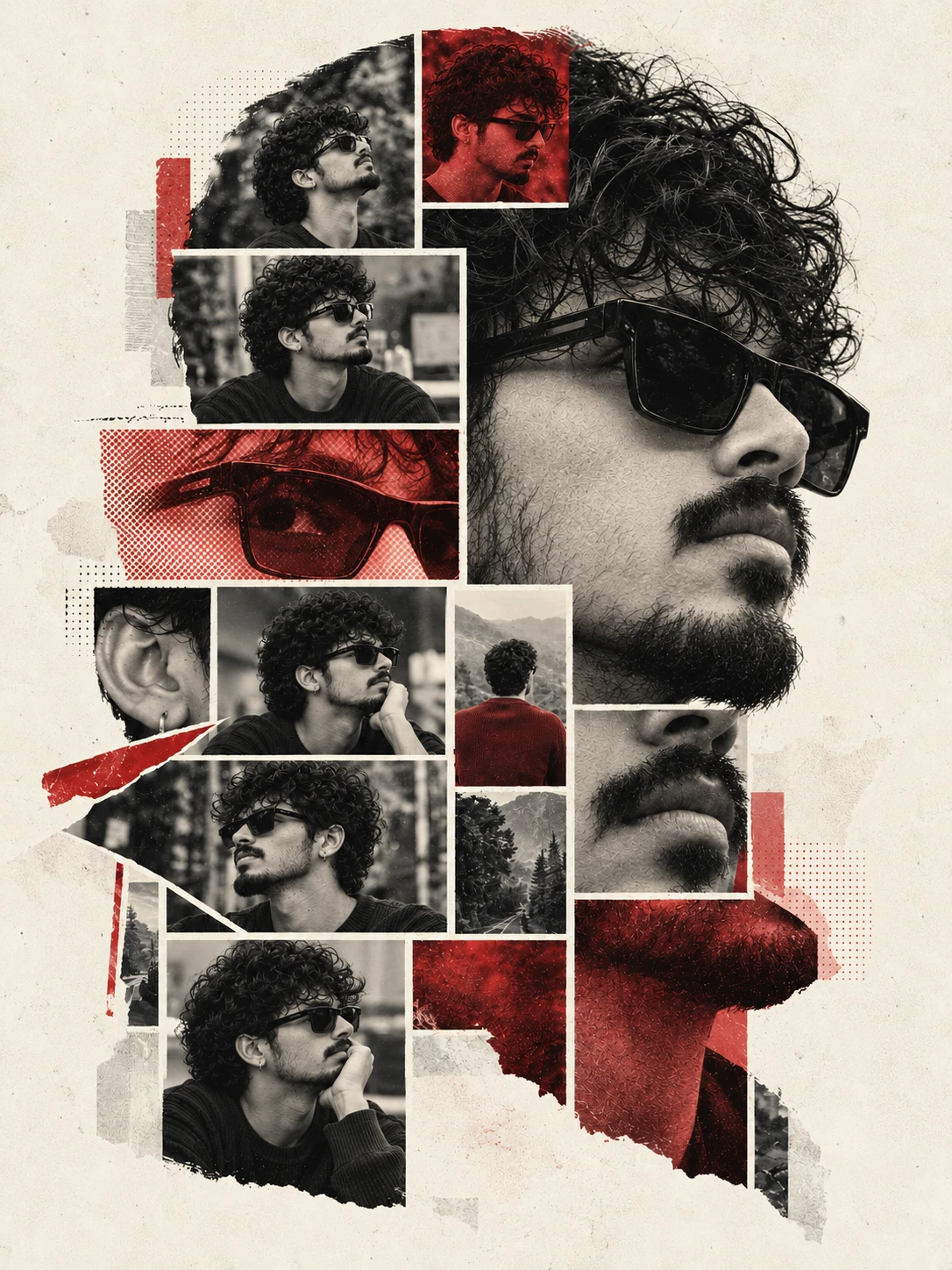
A dramatic close-up surrounded by monochrome photos, crimson halftone texture and torn-paper edges. Build your collage in ChatGPT with a reference photo.
Prompt
Create a highly detailed, photorealistic editorial portrait collage closely matching the supplied reference image. The result should resemble a premium vintage magazine cover assembled from monochrome photographs, torn paper, red halftone textures, and oversized portrait photography.
CANVAS AND FORMAT:
Exact vertical 3:4 Instagram post format, preferably 1536 × 2048 pixels. One complete full-bleed collage on a warm ivory, aged-paper background. Use a sophisticated editorial layout with layered rectangular photo panels, irregular torn edges, narrow cream borders, overlapping images, subtle paper grain, and distressed print textures. The composition must feel intentionally designed, dense but balanced, with no outer frame.
MAIN SUBJECT:
One realistic adult person, male or female, appearing consistently throughout all panels. If a separate identity reference is provided, preserve the person's recognizable identity across every image. The subject has thick, voluminous, naturally curly dark hair, black rectangular sunglasses, realistic skin pores, and subtle facial hair only if appropriate to the person. Maintain consistent facial features, hair, accessories, and overall styling across all photographs.
DOMINANT PORTRAIT:
Place an oversized close-up side-profile portrait across the right half of the composition, occupying approximately 45–50% of the canvas width. The subject faces toward the right, wearing glossy black rectangular sunglasses. Show detailed curly hair, a natural nose profile, lips, cheek, jawline, and realistic skin texture. Use a slightly raised chin and a composed, introspective expression. The portrait should extend from near the upper edge into the middle and lower-right area. Blend portions of the portrait into layered torn-paper shapes and smaller overlapping images without obscuring the facial structure.
SECONDARY PHOTO COLLAGE:
Create approximately 7–9 smaller photographic panels, mostly concentrated on the left side and extending into the lower middle. Vary their sizes and shapes while maintaining a coherent editorial grid. Include these views of the SAME person:
1. A small upper-left black-and-white portrait with the subject looking upward, chin raised.
2. A narrow upper-center vertical portrait with a dark red monochrome treatment and a side-facing pose.
3. A medium horizontal portrait near the upper-left-middle, showing the subject in profile wearing sunglasses.
4. A wide red halftone close-up emphasizing the sunglasses and eye area.
5. A close-up crop of the ear, curls, and side of the face in black and white.
6. A small portrait with the subject resting their chin on one hand while looking sideways.
7. A medium portrait with the subject gazing into the distance, wearing a dark textured outfit.
8. A narrow vertical rear-view photograph showing the subject in a muted red sweater, looking toward a distant mountainous landscape.
9. Additional small portrait or environmental crops integrated into the lower-left area, using the same subject and consistent editorial treatment.
Keep the secondary images visually distinct, as if taken during the same fashion shoot, with varied angles, expressions, and crops. Avoid duplicated panels or inconsistent identities.
WARDROBE:
Use a dark charcoal or black textured shirt, knit sweater, or minimalist jacket in the monochrome portraits. In the rear-view landscape panel, use a deep muted-red sweater. Maintain a cohesive, understated fashion-editorial aesthetic across all panels. Adapt garments naturally to either gender without changing the overall art direction.
BACKGROUND AND PAPER TEXTURE:
Use a warm ivory, slightly yellowed paper background with fine fibers, subtle scratches, faded ink, distressed edges, and gentle aged-paper imperfections. Add sparse black halftone dot grids near the upper-left and lower-right areas. Include a few muted crimson-red rectangular paper fragments, narrow strips, and rough torn red shapes behind the photographs. Add subtle gray paper fragments and distressed printed textures. Keep the cream background visible between the images.
COLOR PALETTE:
Strict editorial palette of warm ivory, black, charcoal gray, faded silver, and deep crimson red. Most portrait photographs are monochrome black and white with slightly warm shadows. Select panels receive a rich red duotone treatment. Red halftone patterns and torn crimson paper provide strong graphic contrast without overwhelming the main face.
LIGHTING AND PHOTOGRAPHIC STYLE:
Soft natural directional light, realistic shadows, crisp facial details, subtle film grain, analog photographic texture, and authentic vintage print contrast. The main portrait should have detailed skin, individual curls, realistic sunglass reflections, and natural facial proportions. Smaller portraits should have slightly varied exposure and grain, resembling photographs printed on textured paper.
LAYOUT AND DEPTH:
Create convincing physical layering through overlapping rectangular photographs, narrow off-white separators, torn edges, partially hidden photo corners, rough cutout silhouettes, and subtle paper shadows. Let the main portrait dominate the right side, while the smaller photos create an irregular vertical collage on the left. Keep the subject's face recognizable and the collage visually legible. Use controlled asymmetry rather than a perfectly uniform grid.
CAMERA AND QUALITY:
Professional fashion editorial photography, realistic portrait-lens rendering, sharp facial features, detailed curly hair, lifelike skin texture, realistic fabric, high-resolution photographic details, and premium magazine-art direction. The final result must look like a carefully art-directed physical collage, not a generic digital grid.
STRICT NEGATIVE CONSTRAINTS:
No typography, words, letters, captions, logos, watermarks, social media interface, borders around the entire canvas, cartoon illustrations, neon colors, excessive decorative stickers, extra people, inconsistent faces, duplicated facial features, malformed sunglasses, distorted ears, artificial skin, or random unreadable text. Do not turn the collage into a clean symmetrical four-panel layout.
FINAL OUTPUT:
One detailed vertical 3:4 editorial collage featuring a dominant oversized monochrome side-profile portrait on the right, multiple smaller black-and-white portraits on the left, selected crimson-red duotone images, red halftone patterns, torn paper textures, and a warm ivory vintage magazine aesthetic. Maintain one consistent subject identity throughout.
About this image
Think of an old magazine page cut up and glued back together, and you are close. A huge black-and-white side profile in sunglasses fills the right half, and around it on the left sit roughly nine smaller torn and overlapping prints of the same person: looking up, resting the chin on one hand, a tight crop of the ear and curls, and a red halftone close-up of the sunglasses. One small panel shows the subject from behind in a red sweater facing misty, pine-covered hills.
Upload a clear photo of yourself to ChatGPT with the prompt and mention that it is the identity reference. The prompt asks for one consistent person across every panel and works for men or women.
Only black, ivory and crimson are allowed, so expect no other colours.
Creator's tip: the biggest panel is a side profile facing right, so a photo that shows your face from the side, or at least at an angle, gives ChatGPT more to match than a straight-on selfie.
Tags: ai photo collage prompt, vintage retro portrait, ai fashion photography
More like this
 Red Scarf AI Photo Prompt – Motion Blur Street Style
 Red Circle AI Photo Prompt – Motion Blur Stairwell
 Night Road AI Photo Prompt – Black and White Blur
 Music Card Face AI Photo Prompt – Black and White Portrait
 Mirror Selfie AI Photo Prompt – Blue LED Wavy Mirror
 Glitch Blur AI Photo Prompt – Sepia Motion Portrait